

Disc Bulges & Herniated Discs Explained by Dr. James Fedich
Hey there! Dr. James Fedich from Village Family Clinic in Hackettstown, New Jersey, here talking about spinal disc bulges and disc herniations.
This is a question I get asked often here at the clinic, so I wanted to give you a little anatomy lesson and share some helpful information.
We have 24 bones in the spine, and between each one is a small disc. These discs act as spacers and shock absorbers for our everyday movements. I tell patients they're a lot like a jelly donut. You have all these fibers that hold the jelly inside.
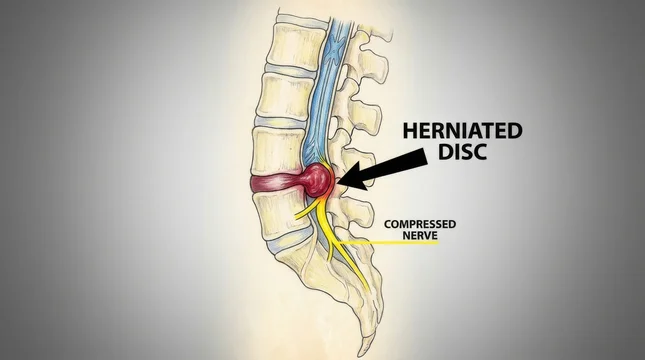
A couple of things can happen with these discs. You can have a disc bulge or a disc herniation. Technically, a bulge is when some of the disc pushes outward but stays contained within the "donut." A herniation, if we're being technical, is when some of the jelly actually comes out of the donut.
Now, one isn't necessarily more painful than the other. The disc is actually one of the only parts of the human body with no nerve supply and no blood supply. So, the disc itself doesn't hurt. When people say, "My disc hurts," or, "I slipped a disc," the disc itself doesn't feel any pain. You could stick a needle into it, and you wouldn't feel it.
It also has no blood flow, so if it gets injured, it doesn't really heal on its own. Unlike when you cut your skin and it bleeds, discs aren't going to naturally heal. If you experience trauma—or, more commonly, the wear and tear of lots of little stresses over time—some of that disc material can bulge or slip out. If it rubs against a nerve, it can be very painful, causing shooting pain, numbness, tingling, burning, and other uncomfortable sensations.
So, what can you do if this happens? There are a couple of treatment options available.
You can take pain medication, which may numb the pain a little bit, although that doesn't always work very well. Another option is an epidural injection. People ask about those a lot. In that procedure, a doctor injects cortisone and lidocaine around the affected nerve to reduce inflammation and help relieve the pain.
Surgery is another option. In some cases, the damaged disc can be removed. Fusion surgery is a major procedure where surgeons remove part of the vertebra, place rods and screws in the spine, and fuse the bones together.
Here at our office, we use spinal decompression. That's the table I'm sitting next to, and it's designed to gently traction the spine and help pull the disc away from the irritated nerve.
Years ago, patients were often placed in traction for these types of problems. They would spend hours in the hospital with continuous pulling on the spine, trying to relieve pressure on the disc. The idea was good, but we found that the body doesn't respond well to being pulled continuously for hours at a time.
Today, we perform decompression treatments in 15- to 20-minute sessions over a series of visits, gently relieving pressure on the affected disc.
Another advantage over traditional traction, like you might find in a physical therapy office, is that standard traction simply pulls and holds. Non-surgical spinal decompression works differently. It pulls, holds, relaxes, and pulls again in a carefully controlled pattern using a servomotor and computer. Not only does this help relieve pressure on the nerve, but that pumping motion also helps the disc rehydrate and heal.
Discs heal best when they're moving, and when they're injured, they often aren't moving properly. This decompression table creates that gentle pumping motion, helping move fluid into the disc and encouraging rehydration.
So, if you or someone you know has a bulging disc, a herniated disc, a slipped disc, or something similar, there are non-surgical, drug-free treatment options available.
Just give us a call or text Village Family Clinic in Hackettstown, New Jersey, at 908-813-8200.